

When booking a cruise, you may notice a significant price difference between cabin categories on the same ship and sailing date. In most cases, an inside cabin is the least expensive option.
The lower price is attractive, but the absence of a window can make the decision difficult. Will the cabin feel too dark or confined? Does staying in a windowless room make seasickness worse? Can two or more travelers comfortably share such a compact space for several days?
The short answer is that an inside cruise cabin is not suitable for everyone. However, it can offer excellent value if you primarily use your cabin for sleeping and showering while spending most of your time exploring the ship or visiting ports.
On the other hand, an ocean-view or balcony cabin may provide better value for travelers who prioritize natural light, ocean scenery, privacy, and quiet time in their room.
This inside cruise cabin review covers the main advantages and disadvantages of windowless cabins, including space, darkness, seasickness, noise, cabin location, guarantee fares, and useful items to pack.
What Is an Inside Cruise Cabin?
An inside cabin is a stateroom located in the interior section of a cruise ship. On international booking websites, it may be listed as an Inside Cabin, Interior Cabin, or Interior Stateroom.
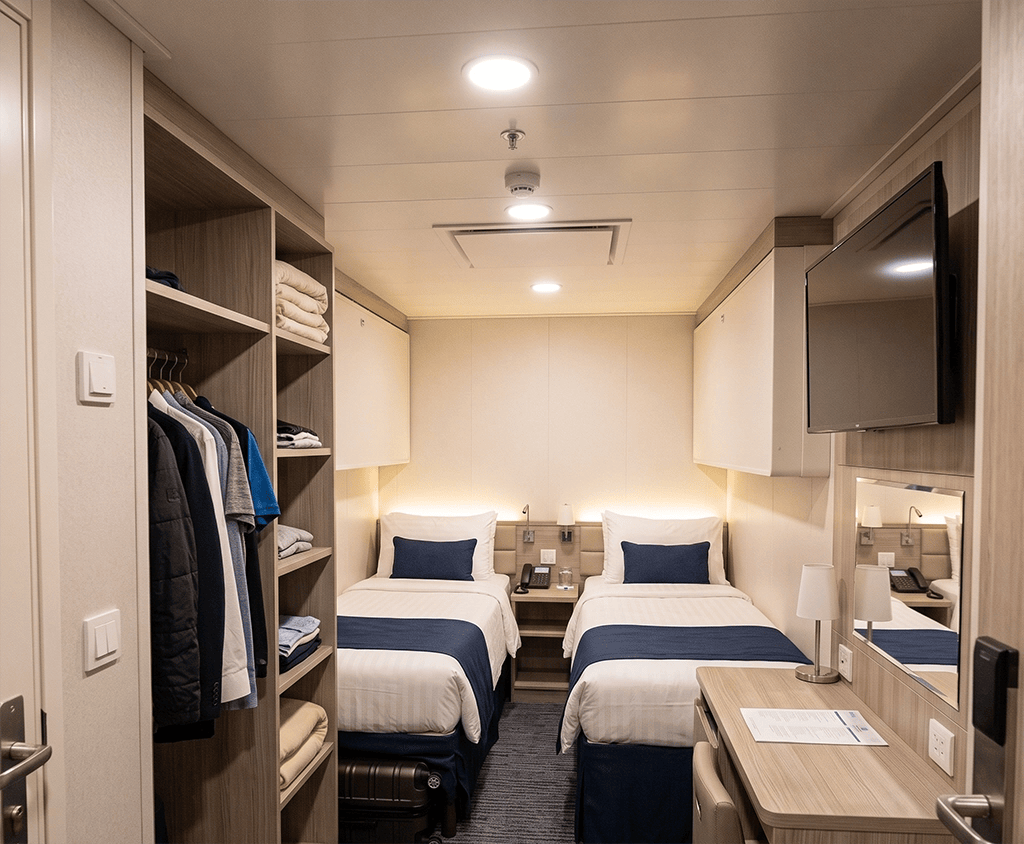
Inside cabins do not have an exterior window or private balcony. However, they generally include the same essential facilities found in standard ocean-view cabins, such as:
- Beds
- Private bathroom
- Television
- Wardrobe
- Desk or vanity
- Telephone
- Individually controlled air conditioning
- Basic in-room storage
- Bedside lighting
Cabin size and layout vary by cruise line, ship, and subcategory. Even inside cabins on the same ship may have different floor areas, bed arrangements, occupancy limits, and connecting doors.
In many cabins designed for two passengers, two single beds can be combined into one larger bed. Cabins accommodating three or four guests may include a sofa bed or additional beds that fold down from the wall or ceiling.
Do not rely only on the sample photograph shown on the booking page. Before paying, check the exact cabin category, floor area, bed configuration, maximum occupancy, and whether the room has a connecting door.
Is a Windowless Cruise Cabin Really Comfortable?
The biggest difference between an inside cabin and other standard cabins is usually not the floor area. It is the complete absence of natural light.
When the lights are switched off, an inside cabin can remain completely dark even in the middle of the day. This can be excellent for light-sensitive sleepers, but it may feel disorienting to travelers who naturally wake up when sunlight enters the room.
You cannot immediately tell whether it is morning, cloudy, raining, or whether the ship has arrived in port. Setting a phone alarm and checking the ship’s exterior camera channel on the television can reduce this inconvenience.
Some ships offer virtual balcony cabins. These are inside cabins equipped with a large digital screen displaying a live view from outside the ship.
A virtual balcony is not a real window, but it may reduce the sense of being enclosed by showing the sea, weather, and port conditions. Availability is limited to specific ships and cabin categories, so look for the term Virtual Balcony on the reservation page.
Advantages of an Inside Cruise Cabin
Lower Cruise Fare
Price is the most obvious advantage of an inside cabin.
On the same sailing, an inside cabin is generally less expensive than an ocean-view cabin, balcony cabin, or suite. The exact difference depends on demand, itinerary, cruise line, ship, season, and how early you book.
The money saved can be used for other parts of the trip, including:
- Shore excursions
- Specialty dining
- Beverage packages
- Wi-Fi packages
- Spa treatments
- Transportation to the port
- Hotels before or after the cruise
- Travel insurance
If you do not plan to spend much time in your cabin, paying considerably more for a view may not provide enough additional value.
For active travelers, using the savings for a memorable shore excursion or an extra night at the departure city may improve the overall trip more than upgrading the cabin.
Excellent Darkness for Sleeping
With no exterior window, an inside cabin becomes very dark when the lights are off.
This can be useful on summer cruises with long daylight hours, itineraries involving time-zone changes, or trips where you want to rest after a full day of activities.
However, the darkness can also make it easy to oversleep. Set an alarm, request a wake-up call, or use a small clock that remains visible during the night.
Encourages You to Use the Ship
Passengers staying in inside cabins often spend more time exploring the ship’s public areas.
Instead of remaining in the room for the view, you may be more likely to use:
- Pools and sun decks
- Observation lounges
- Theaters
- Promenades
- Cafés
- Libraries
- Fitness centers
- Adult-only areas
- Live entertainment venues
On a large ship with frequent shows, classes, dining options, and deck activities, you may spend so little time in the cabin that the absence of a window becomes a minor issue.
More Budget for Experiences
An inside cabin can be particularly valuable when the fare difference is large.
Instead of paying for a higher cabin category, travelers may be able to book a guided shore excursion, upgrade a dining package, or add several paid onboard experiences without increasing the total holiday budget.
This approach works best when the cruise is itinerary-focused and includes frequent port days.

Disadvantages of an Inside Cruise Cabin
No Natural Light or Ocean View
An inside cabin does not allow you to watch the sea, check the weather, or see the ship arriving in port from your room.
If waking up to an ocean view is an important part of your idea of a cruise, an inside cabin may reduce your satisfaction.
The difference is especially important on scenic itineraries such as:
- Alaska
- Norwegian fjords
- Panama Canal
- Glacier-viewing cruises
- Hawaii
- New Zealand
- South America
- Mediterranean sailings with scenic port approaches
On these routes, the view is not limited to a few hours in port. The surrounding landscape may be one of the main reasons for choosing the itinerary.
Possible Sense of Confinement
Travelers who are sensitive to enclosed spaces may feel uncomfortable in a compact room without a window.
Consider your everyday reactions to elevators, underground rooms, windowless offices, or small hotel rooms. If these environments make you uneasy, booking a windowless cabin for a long cruise could be stressful.
A first-time cruiser with concerns about confinement should avoid testing an inside cabin on a cruise lasting ten nights or longer.
A three-to-five-night cruise is a more practical way to find out whether a windowless cabin suits you.
Limited Space for Three or Four Guests
An inside cabin can be manageable for one or two travelers when belongings are kept organized.
With three or four adults, however, space can become limited after the additional beds are opened. Access to the wardrobe, desk, entrance, and bathroom may also become more difficult.
The bathroom is shared by everyone in the cabin, which can create delays when several passengers need to shower and prepare at the same time.
Families and groups should compare the total prices of:
- A larger ocean-view cabin
- A balcony cabin
- A family cabin
- Two inside cabins
- Connecting cabins
- One inside cabin and one ocean-view cabin
Two smaller cabins may sometimes be more practical than fitting four people into one cabin because they provide two bathrooms and additional storage.
Does an Inside Cabin Make Seasickness Worse?
A windowless cabin does not automatically move more than an ocean-view or balcony cabin.
The amount of motion you feel depends more on the cabin’s position, the ship’s size and design, sea conditions, speed, wind, and sailing route.
In general, movement is often less noticeable near the middle of the ship than at the bow or stern. A cabin on a lower or middle passenger deck near the ship’s center may therefore be more comfortable for travelers who are sensitive to motion.
However, an inside cabin does not provide a view of the horizon. Some passengers find that looking at the horizon helps their senses adjust to the ship’s movement.
An ocean-view or balcony cabin may be more comfortable if you frequently experience motion sickness and rely on visual contact with the horizon.
When selecting a cabin for motion sensitivity, prioritize:
- A midship location
- A lower or middle passenger deck
- Easy access to an outdoor deck
- Reasonable proximity to elevators
- A route with fewer consecutive sea days
- A larger or more modern ship if other factors are similar
An inside cabin near the ship’s center may feel more stable than a balcony cabin located high at the bow or stern. Cabin category alone does not determine comfort.
How to Choose a Quiet Inside Cabin
Many negative inside cruise cabin reviews are caused by noise rather than the absence of a window.
Before booking, open the ship’s deck plan and inspect the spaces beside, above, and below the cabin you are considering.
Locations That May Be Noisy
Consider avoiding cabins located:
- Directly above or below a theater
- Near a nightclub or music venue
- Below the pool deck
- Below areas where loungers are moved
- Below a buffet or restaurant
- Near a galley
- Beside a crew service area
- Next to a laundry room
- Near an ice machine
- Directly beside an elevator lobby
- Near a frequently used stairwell
- Close to mechanical or anchor-related areas
- Beside a connecting door
A cabin under the pool deck may receive noise when crew members move loungers early in the morning. A cabin near a theater or nightclub may be affected by music, vibration, or late-night foot traffic.
The safest general choice is a cabin located between two decks of passenger cabins. If the spaces above and below are both staterooms, the risk of noise from major public facilities is usually lower.
Check the Connecting Door
Connecting cabins are useful for families and groups, but the door between rooms may make conversations or television noise more noticeable.
If you do not need a connecting cabin and are sensitive to sound, select a room without a connecting-door symbol on the deck plan.
Consider Distance From Elevators
A cabin near the elevators can be convenient, particularly on a large ship.
However, a room immediately beside the elevator lobby may receive more noise from passengers returning late at night or gathering before excursions.
A practical compromise is to choose a cabin a short distance down the corridor rather than directly beside the elevator.
Guarantee Inside Cabin vs. Selecting a Cabin Number
A guarantee cabin allows you to reserve a cabin category without choosing the specific room number. It may appear as a Guarantee Cabin, Guaranteed Stateroom, or GTY fare.
The cruise line assigns the cabin later.
A guarantee inside cabin can offer a lower price, and there is sometimes a possibility of receiving a higher subcategory. However, an upgrade within the inside category may still result in a location you would not have chosen yourself.
Possible assignments include cabins:
- Near elevators
- At the bow or stern
- Under a public venue
- Close to crew work areas
- Far from preferred facilities
- On a deck you would not normally select
Once the cabin has been assigned, changing it may be difficult, unavailable, or subject to an additional charge.
A guarantee cabin may suit travelers who:
- Prioritize the lowest price
- Are not sensitive to noise
- Do not experience significant seasickness
- Are comfortable walking longer distances
- Have no strong deck preference
- Will accept any cabin within the booked category
Paying more to select a cabin number may be worthwhile if you are a light sleeper, have mobility concerns, experience motion sickness, or want to stay close to particular facilities.
Who Should Choose an Inside Cruise Cabin?
An inside cabin may offer excellent value for travelers who:
- Use the cabin mainly for sleeping and showering
- Participate in onboard shows and activities
- Spend most port days away from the ship
- Sleep well in a dark room
- Prefer spending money on excursions and dining
- Are taking a short cruise
- Travel alone and prioritize price
- Spend most of the day around the pool or public lounges
- Do not feel uncomfortable in enclosed spaces
- Have booked a port-intensive itinerary
An inside cabin may work particularly well on a three-to-five-night cruise with several port calls and limited time at sea.
It can also be efficient on a modern resort-style ship where entertainment, dining, and recreation keep passengers outside their cabin for most of the day.
Who Should Avoid an Inside Cruise Cabin?
Compare ocean-view and balcony cabins if you:
- Feel anxious in windowless spaces
- Need natural light to wake up comfortably
- Plan to spend long periods in the cabin
- Are traveling with a baby or toddler who needs daytime naps
- Are cruising with parents who may rest in the room frequently
- Plan to place three or four adults in one cabin
- Are taking a long cruise with many sea days
- Are booking an itinerary where scenery is a major attraction
- Are celebrating a honeymoon or anniversary
- Want private outdoor space
- Work remotely and need a comfortable daytime environment
- Depend on watching the horizon to manage motion sickness
A higher cabin category is not automatically necessary, but the upgrade may provide meaningful value when the room itself is an important part of the holiday.
Useful Items for an Inside Cruise Cabin
A few compact items can make a windowless cabin more comfortable and easier to organize.
Rechargeable Night-Light
An inside cabin can become completely dark when the main lights are off.
A small rechargeable or battery-operated night-light makes it easier to use the bathroom without switching on a bright ceiling light and waking your travel companion.
Choose a model with low brightness or adjustable light levels.
Magnetic Hooks
Many cruise cabin walls and doors contain metal surfaces that can hold magnets.
Magnetic hooks can create additional storage for lightweight items such as:
- Hats
- Lanyards
- Cruise cards
- Small bags
- Lightweight jackets
- Daily schedules
Do not hang excessively heavy items. Bring hooks with a realistic weight capacity and test them before relying on them.
Adjustable Digital Clock
Because there is no natural light, a small clock can help you understand the time without repeatedly checking your phone.
Choose one with an adjustable or dimmable display. A bright screen may disturb your sleep in an otherwise dark cabin.
Packing Cubes
Packing cubes help separate clothing and small personal items in a compact space.
After boarding, unpack essential items into the wardrobe and drawers. Store the empty suitcase under the bed if the cabin design allows it.
Keeping the floor clear makes a small inside cabin feel significantly more comfortable.
USB Multiport Charger
Some cabins, particularly on older ships, have limited charging outlets.
A compact USB charger can allow several devices to charge from one permitted outlet. Cruise lines may restrict extension cords, power strips, and devices with surge protection.
Check the cruise line’s prohibited-items policy before packing any multi-outlet device.
Sunrise Alarm Clock
A compact sunrise alarm can gradually brighten the room in the morning, creating a more natural wake-up experience.
This can be helpful for travelers who struggle to wake up in complete darkness. Confirm that the device is permitted and compatible with the cabin’s available power supply.
Cruise Line App
Download the cruise line’s app before departure and complete any required login or check-in steps.
Depending on the cruise line and ship, the app may provide:
- Daily schedules
- Restaurant reservations
- Show bookings
- Port information
- Onboard messaging
- Account charges
- Ship maps
- Arrival information
A phone cannot replace a window, but access to the daily schedule and ship information can make an inside cabin feel less disconnected.

Inside vs. Ocean-View vs. Balcony Cabin
The cheapest cabin is not automatically the best value, and the most expensive cabin is not automatically necessary.
Compare how you will actually use the room.
Choose an Inside Cabin When
- The price difference is substantial
- The cruise lasts three to five nights
- The itinerary has frequent port calls
- The ship offers many onboard activities
- You use the room mainly for sleeping
- One or two passengers will share the cabin
- Enclosed spaces do not bother you
- You prefer spending money on excursions or dining
- The view is not central to the itinerary
Choose an Ocean-View Cabin When
- Natural light is important
- You want to check the weather from the room
- You are concerned about feeling enclosed
- The price difference from an inside cabin is small
- You do not need a private outdoor space
- You will spend some daytime hours in the room
- You want to see the horizon without paying for a balcony
Remember that some ocean-view cabins may have obstructed views, unusual window shapes, or windows positioned above the bed. Review the exact category description before booking.
Choose a Balcony Cabin When
- You expect to spend considerable time in the cabin
- You want a private place to enjoy the sea
- The itinerary includes several sea days
- The scenery is a major reason for the trip
- You are celebrating a special occasion
- You want more natural light
- You are traveling with someone who rests in the room frequently
- You value fresh air and private outdoor space
- The upgrade price fits comfortably within your budget
A balcony can be particularly valuable on scenic or longer itineraries. On a short cruise with a busy schedule, you may have limited time to use it.
Booking Checklist for an Inside Cruise Cabin
Before completing your reservation, check the following information:
- Exact cabin floor area
- Bed configuration
- Type of additional beds
- Maximum occupancy
- Connecting-door status
- Facilities on the deck above
- Facilities on the deck below
- Distance from elevators and stairs
- Midship, forward, or aft location
- Deck height
- Guarantee or selected-cabin fare
- Virtual balcony availability
- Accessible or specially configured cabin status
- Cancellation conditions
- Cabin-change conditions
- Number of sea days
- Number of port days
- Importance of scenery on the itinerary
- Expected amount of time spent in the cabin
- Total price difference between categories
Do not compare only the headline cruise fare. Taxes, port fees, gratuities, drinks, dining, internet, excursions, and transportation may have a greater effect on the total cost than the cabin upgrade itself.
Final Verdict: Is an Inside Cruise Cabin Worth It?
The central question behind most inside cruise cabin reviews is simple: can you comfortably spend several nights in a cabin without a window?
For travelers who use the cabin mainly for sleeping and showering, the answer is often yes. The dark room can support restful sleep, and the lower fare may leave more money for excursions, meals, and other experiences.
However, an inside cabin is less suitable for travelers who need natural light, feel uncomfortable in enclosed spaces, or spend significant time relaxing in the room.
Cabin location can matter as much as cabin category. A quiet inside cabin near the middle of the ship may provide a better experience than a higher-category cabin below a noisy pool deck or nightclub.
Before booking, inspect the deck plan and check what is located above, below, and beside the cabin. Travelers concerned about motion should prioritize a midship cabin on a lower or middle deck.
If this is your first cruise, trying an inside cabin on a three-to-five-night itinerary is a sensible approach. You can determine whether the lower fare is worth the lack of natural light before committing to a longer voyage.

